Sunken driveways and aprons
One section sits lower than the garage, curb, or neighboring slab, creating a dip where tires cross or water collects.

Raise sunken concrete without replacing the slab. High-density polyurethane is injected through small ports in the slab. It expands, fills the void, and raises the concrete back to grade. The material is lightweight and closed cell, and our estimate starts with measuring the soil beneath the slab.
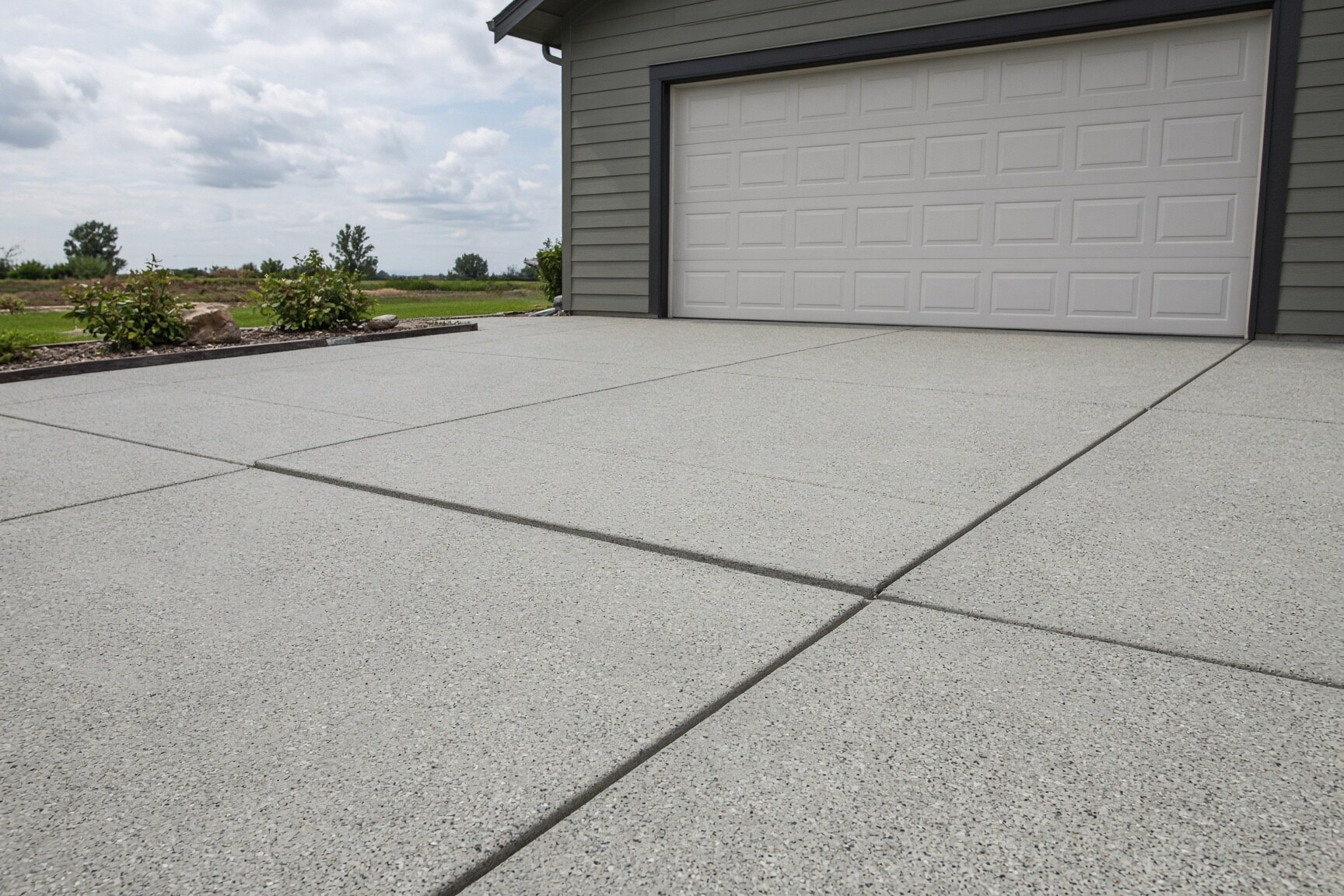
One section sits lower than the garage, curb, or neighboring slab, creating a dip where tires cross or water collects.
Slab edges no longer meet evenly, leaving a trip point or causing chairs, tables, and foot traffic to feel unstable.
The floor has pulled away from walls, door thresholds, or adjoining slabs, or equipment no longer sits level.
Concrete has dropped beside the pool, coping, porch, or stair, opening joints and changing the intended drainage slope.
If it is concrete sitting on soil, it can usually be lifted. The question is what the soil underneath is doing.
Sunken panels, dips at the garage threshold, and low sections where water pools instead of draining to the street.
Trip points at slab edges, patios that pitch toward the house, and coping that dropped away from the pool shell.
Interior slabs lifted through small ports without moving equipment, demolishing the floor, or pouring new concrete.
Entry slabs that settled away from the structure, opening a gap at the threshold and changing the step height.
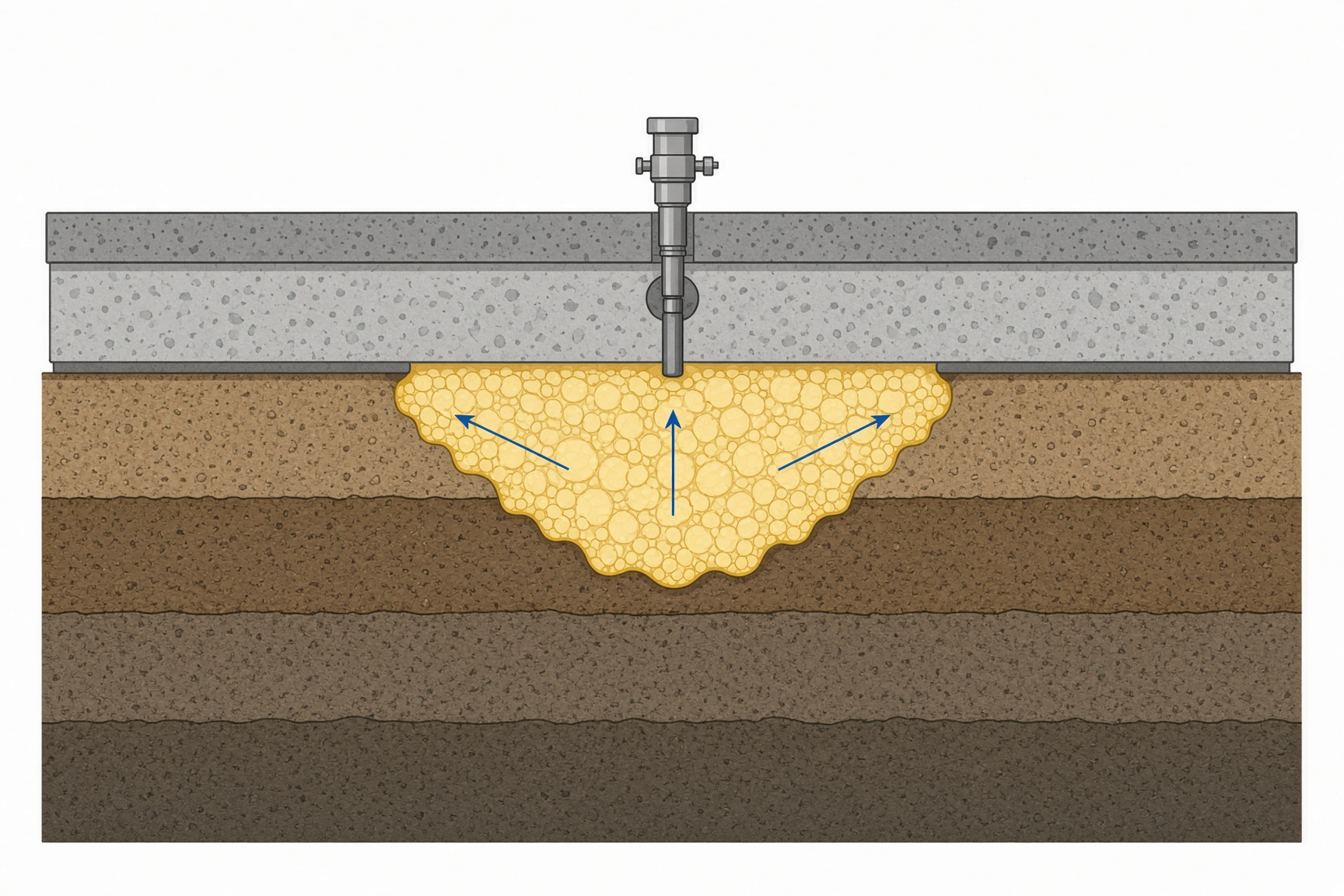
We walk the site and take penetrometer readings to understand the soil and the void beneath the concrete.
Ports about 5/8 inch across are placed in a pattern designed to lift the slab evenly.
High-density polyurethane expands under the slab while we monitor the lift.
Ports are patched, the site is cleaned, and the slab can be used right away.
Foam lifts slabs. It does not repair a footing that moved, and it will not hold if the soil below is still washing out. That is why the estimate starts with penetrometer readings instead of a price.
Stair step cracks, binding doors, and sloping floors point to the structure rather than the surface. That work needs piers, brackets, or jacks.
Foundation repairIf a void keeps reopening, filling it again will not last. The water path has to be addressed alongside the fill.
Soil stabilization and void fillA Boise garage floor and driveway had settled more than six inches, with a large void beneath the garage floor. Poly Flow filled the void first, then lifted both slabs slowly and systematically.
Most recent Poly Flow work documented for concrete lifting.
This is a common issue on new construction with basement foundations. After forming and pouring the basement walls, excavation spoils are backfilled against the foundation. I…
Read the projectDuring a remodel, a basement was added beneath an existing home. To create the basement footprint, the soils around the house were excavated and later backfilled without bein…
Read the projectA durable repair starts with the right diagnosis. Use these answers to understand the options, compare proposals, and know what a site-specific evaluation still needs to determine.
A useful evaluation looks beyond the visible low spot. Settlement can result from poorly compacted fill, soil movement, erosion, leaking drainage, or water repeatedly washing material from beneath a slab. Poly Flow performs on-site penetrometer testing to help assess the supporting material and identify weak or inconsistent areas before proposing a lift. The contractor should also inspect cracks, joints, slab thickness where observable, nearby downspouts, grading, and signs of ongoing water problems. No surface inspection can reveal every underground condition, so diagnosis has limits. Ask what evidence supports the recommendation, whether drainage or plumbing concerns should be addressed first, and what could cause renewed movement. Lifting corrects elevation and support; it does not automatically eliminate the underlying source of settlement.
Polyurethane lifting may fit a settled but largely intact driveway, patio, sidewalk, garage or shop floor, pool deck, or step where restoring elevation can improve slope, alignment, or support. It is less suitable when concrete is extensively crumbled, severely spalled, structurally broken into unstable pieces, too thin or weak to lift safely, or already near the end of its useful life. A slab may also be non-liftable when access is inadequate, movement could damage an adjoining structure, underground conditions cannot provide reliable support, or the required position cannot be achieved without unacceptable stress. Poly Flow-specific suitability should be determined after site evaluation and penetrometer testing. Homeowners should ask whether the proposal addresses the entire affected area or only the most visible symptom.
The crew first confirms the planned lift, reviews surrounding surfaces and utilities, and establishes reference elevations. Poly Flow uses on-site penetrometer testing as part of evaluating subsurface conditions. For the lift, roughly 5/8-inch ports are drilled through the slab in selected locations. High-density, closed-cell polyurethane is injected beneath the concrete, where it expands. The crew monitors slab movement and adds material incrementally to control the lift rather than attempting one large correction. Afterward, the injection ports are patched and the work area is cleaned. Poly Flow states that treated surfaces can return to use the same day, although homeowners should follow the crew's specific timing and any access instructions. Exact port placement, injection quantity, and achievable elevation depend on site conditions discovered during the work.
Lifting preserves the existing slab, while replacement removes it and installs new concrete. Lifting is often worth considering when the slab remains serviceable but has lost support or elevation. Replacement may be the better investment when concrete is extensively deteriorated, badly fractured, incorrectly shaped, too thin, or needs a redesigned base, thickness, reinforcement plan, or layout. Traditional cement-based slabjacking is another lifting method; it generally uses larger access holes and a heavier grout, while polyurethane uses expanding foam through smaller ports. Grinding can reduce a minor trip edge but does not restore support or correct broad drainage slope. Topping or patching may improve appearance temporarily without resolving movement below. Ask for the reasoning behind each option, not simply which one has the lowest initial disruption.
Concrete lifting is controlled adjustment, not complete reconstruction. It may not close every crack, restore the original appearance, produce a perfectly level surface, or return every edge to its exact former position. Existing cracks can remain visible and may open, close, or change during lifting. Stains, spalling, scaling, and other surface defects are not repaired by raising the slab. Hidden obstructions, weak concrete, attached structures, reinforcement, or unstable subsurface conditions can limit how far or how evenly a section can move. The injected material fills selected voids and supports the slab, but it cannot correct active drainage leaks or every soil problem. Before authorizing work, request realistic target elevations, areas that may remain imperfect, crack-repair scope, and the conditions that could require stopping the lift.
Durability depends on more than the foam itself. High-density, closed-cell polyurethane is intended to provide support beneath the slab, but long-term performance also depends on concrete condition, soil stability, drainage, erosion, nearby excavation, and whether water continues entering the area. Poly Flow offers a five-year no-settle guarantee on lifts. Because guarantee terms can define settlement, exclusions, covered areas, transferability, and available remedies, ask to read the written document before purchasing rather than relying on a verbal summary. Confirm whether crack movement, adjacent untreated slabs, drainage-related movement, or new soil loss is excluded. General education cannot predict the service life of a particular repair; a site-specific proposal should explain known risks and what evidence would be needed if movement is suspected later.
Polyurethane lifting usually avoids demolition and the hauling, forming, pouring, and curing associated with full replacement, but it is not disruption-free. The crew needs room for equipment and hoses, drills roughly 5/8-inch ports, and may temporarily restrict access around the work zone. Drilling creates noise and dust, and port patches will remain visible, especially where color and texture differ from aged concrete. Furniture, vehicles, planters, and other obstacles may need to be moved in advance. Delicate edges, coatings, adjoining masonry, pool components, or finished interiors require added planning. Poly Flow states that lifted surfaces can be used the same day; homeowners should still obtain exact instructions for vehicles, equipment, pool use, doors, and any sealant or patch materials used on their project.
Cost commonly reflects the number and size of slabs, amount of settlement, estimated void volume, foam quantity, required lift precision, drilling pattern, equipment access, and complexity around buildings, pools, steps, doors, or utilities. A small area can be demanding if access is tight or movement must be carefully coordinated with adjoining surfaces. Conversely, a larger open slab may be comparatively straightforward. Diagnostic work, crack or joint treatment, drainage corrections, patching expectations, travel, mobilization, and warranty scope can also affect a proposal. Because underground voids are not fully visible beforehand, ask how material overruns or changed conditions are handled. Compare written scopes line by line: included slabs, target elevations, port repair, cleanup, exclusions, payment schedule, and whether follow-up adjustment is part of the quoted work.
Follow the project-specific access instructions even though Poly Flow identifies same-day use as a feature of its lifting process. Confirm when vehicles, heavy equipment, patio furniture, or pool traffic may return, and ask how to care for fresh port patches or any separate crack and joint materials. Longer term, direct roof and surface water away from slab edges, keep drainage paths open, repair known leaks, and avoid allowing sprinklers or downspouts to repeatedly saturate the supporting soil. Do not assume caulk alone solves a subsurface water problem. Periodically observe slopes, joints, cracks, and transitions to adjacent concrete, using dated photos or simple measurements if something changes. Report suspected movement promptly and retain the proposal, guarantee, invoices, and before-and-after documentation needed for a service request.
Ask who will evaluate and perform the work, what testing supports the diagnosis, and why lifting is preferable to replacement for each slab. Request a marked scope showing treated sections, approximate port locations, target elevations, expected residual unevenness, crack treatment, cleanup, and excluded work. Ask what could make the slab non-liftable or cause the crew to stop, how nearby foundations, utilities, drains, doors, pool features, and finished surfaces will be protected, and how unexpected voids affect price. Confirm the polyurethane type and request the product's technical and safety information. For Poly Flow, verify that the proposal reflects its on-site penetrometer testing, high-density closed-cell polyurethane, monitored lift, same-day-use guidance, and written five-year no-settle guarantee terms. Also confirm insurance, scheduling, payment milestones, and the process for documenting concerns afterward.
Estimates are free and done on site. We test the soil before we quote, so the price reflects the actual problem.